
There are quite a few things I feel like people forget to mention about learning to trust yourself as a recovering people-pleaser who spent years people-pleasing and living your life by the expectations of others. Here are 14 of those things…and no, they’re not all bad.
#1: People forget to mention that operating in self-trust does not always give you a positive outcome.
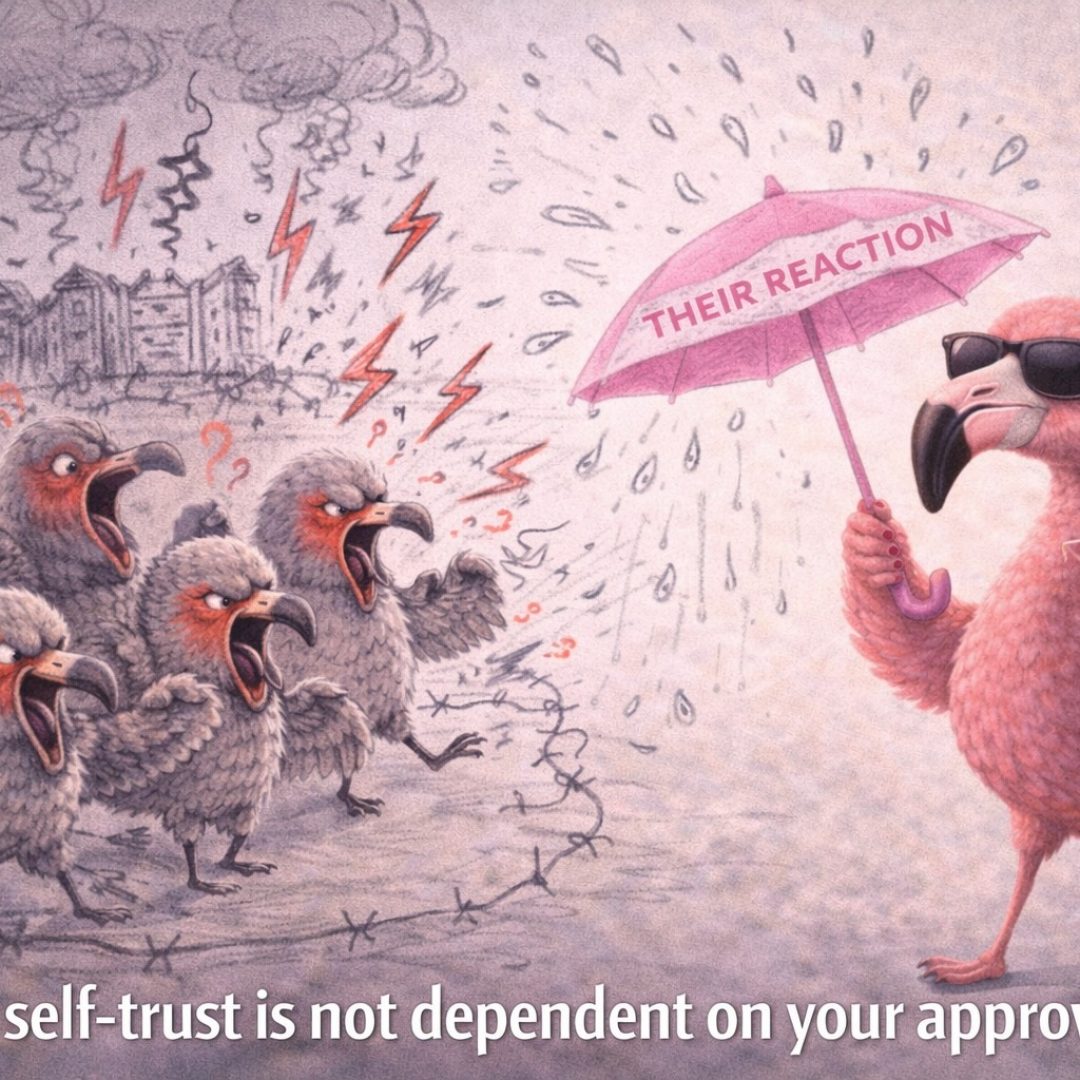
That you can do the thing you know is right for you AND everyone, yet people will hate you for it. That things can get hard. Relationships will fall apart. Loved ones will be disappointed and feel like you’ve betrayed them. People will push back and react badly. People will try to make you feel guilty for daring to walk away from how things have always been done. When people’s reactivity kicks in, you benefit greatly from building the ability to stand resolute even when you’re discomforted by their reactivity to your actions. To not walk away from the process because things got hard and people got nasty/difficult/disappointed. To not get consumed by guilt when you know that the action you took aligns with God’s will and honours you and that person. To confidently stand and remain grounded, no matter the reaction of others.
#2: People forget to mention how hard it is at first to discern which voice is truly yours vs what other people have told you about you for most of your life.
That’s a byproduct of years of listening to other’s voices while ignoring your voice and intuition as you show up as what everyone expects. Now, you’re on a journey to dig into the layers of all the voices and tune your ears to your truest unfiltered voice. And when you’re trying to walk God’s path for you, now you must learn how to discern your voice from God’s voice from the voices of others.
#3: People forget to mention that when you’re a believer in God, entertaining the idea of trusting yourself can feel ungodly.
With scriptures like “the heart is deceitful” and “lean not on your own understanding.”, it is easy to fall into self-doubt. I remember the mental exhale I felt when I read about intuition in the book of Job. My intuition becomes increasingly trustable the more I reprogram it to align with non-people-pleasing ways of being. And because I’m a Jesus-girl through and through, I also desire a level of self-trust rooted in my God-given identity and God’s ways of being for me. I remember the sense of peace I felt in realizing that God gave us the gift of choice and that gift requires a level of self-trust in our ability to make great decisions. Like the manufacturer of a dishwasher, He designed us and knows how best we’re designed to function. Like the manufacturer who gives us a manual for the dishwasher (and a support hotline to call), He gives us the Bible and keeps an open invitation for us to partner with Him and learn how we were designed to function optimally.
#4: People forget to mention that “trust yourself” is not a hall pass to trust yourself wholly and completely.
That you need to rewire your old way of being and have a practical system to assess and spot your biases or blindspots. You spent an entire life-time people-pleasing and self-sacrificing. Your way of being (thoughts, beliefs, emotions, and behaviours) was preprogrammed to meet people’s expectations in every area of life, even at the expense of yourself. That pre-programming means that every day you make intuitive subconscious snap decisions geared towards that outcome, even when you’re healing and doing the work. Trusting yourself without that intentional rewiring and that assessment system is folly that keeps you trapped and unable to see the very patterns you’re trying to heal from.
#5: People forget to mention that learning self-trust is directly connected to your ability to trust God, especially after all the times He proved you couldn’t trust Him.
After all the times He let you down. After religion made you believe self-sacrifice was the only acceptable way to show love to others. So, you became the strong one who gave, showed up and held everything together, because He didn’t love you enough to show up and protect you. I’ve spent many a times raging at God about past events where I thought He was absent. Where I felt it was unfair that I had to carry weights that were too heavy to bear. And I didn’t trust myself or feel the freedom to release those weights and the control needed to carry them until I started learning to trust God again.
#6: People forget to mention that the same rules, feelings, and thoughts regarding God also apply with the people in your life.
Your self-trust matures the more you regain trust in the ability of the people in your life to hold you up and pour into you instead of you being the one who does it all.
#7: People forget to mention that as you develop self-trust and return to yourself, there will be moments where all you feel is immense grief, regret and anger at yourself and others.
Where you grieve the version of yourself that carried weight and responsibilities that you should never have had to carry in the first place. That there will be moments when you finally face and admit the depth of the anger you carry towards the people you loved who let you down or weren’t there to hold you in the ways you needed.
#8: People forget to mention that developing self-trust requires honesty about the past and present.
Deep emotional honesty – that’s scary when you spent a lifetime suppressing and ignoring your emotions so you could be what others need. You need to face the past with emotional honesty. And without practical tools to effectively face the emotional moments of tomorrow, you will fall apart or mistrust your ability to show up grounded and confident in the moments that matter most.
#9: People forget to mention that there is a seductive version of self-trust that’s rooted in self-protection.
Should you heed its call, you’ll exchange one extreme protective mask for another. Where you’ll harden your heart to others and do things that don’t align with your personal values because your past experiences and pain skew your perspective. You place yourself behind a wall and cut people off to protect your peace or avoid getting triggered. Accepting that seductive call is a reactive move that leaves you alone and devoid of the love, acceptance and safety you truly desire.
#10: People forget to mention that as you embrace deeper self-trust and unlearn the thoughts and beliefs that influenced your people-pleasing, more layered fruits of those beliefs and behaviours are guaranteed to emerge.
These are fruits on higher branches that are rarely talked about in relation to people-pleasing but propagate and affect every area of your life. And so, your commitment to healing is a commitment to getting equipped to discover and unlearn all the low-hanging and high-hanging fruits of your people-pleasing. And replacing those beliefs and ways of being with ones that aligns with who God created you to be, in every area of life. So, you completely stop self-sacrificing, silencing your voice and trading in the ways you were designed to operate for the opinions, expectations, and good will of others.
#11: People forget to mention that even as you make progress and follow your intuition, there will be times when you confidently take a step only to realize it was a misstep.
And that misstep stings. It drives a stake to the heart of your fledging confidence. Sometimes, that misstep means you accidentally hurt others and you’re left wondering “how can I trust myself after this?” And then the shame and frustration step in, followed by the belief that “After all the healing I’ve done, I’m still at square one”. And if you don’t have the identity-driven relational and emotional tools to silence your mean inner critic and get up again, that shame and belief can consume you and cause you to give up.
#12: People forget to mention that learning to trust yourself is hard when you have no vision of what healthy self-trust can looks like for you.
After years of people-pleasing and self-suppression and doubt, all I knew was what unhealthy people-trust looked like. I had a barely-there mental image of what self-trust looks like much less the levels of self-trust that was possible. I needed vision of what’s was possible for me and the safety and freedom to hope and dream. I was blessed to be in relationship with people who sparked my imagination and inspired my ability to dream again and dream bigger about what was possible for me. That birthed my vision of self-trust that gets uplevelled each time I get an exceedingly abundant picture of the possibilities.
#13: People forget to mention that a huge part of recovering from people-pleasing and learning self-trust lies in changing your relationship with your resources and how you allocate them to the people.
I had to learn how to use my money, time, ideas, body and other resources in ways that honour God, me AND others. No more giving and pouring just because I can. No more doing the bare minimum for myself or ignoring my bodily needs and functions. No more hoarding or misusing resources because I’m planning ahead and trying to control certain outcomes and get people to respond a particular way. It required learning stewardship of people and resources – including myself. And a part of that stewardship required total honesty about what I want and desire. I had to discover my taste and preferences when it came to stuff like food, hairstyle, clothes, music, movies, books, etc.
#14: Finally, people forget to mention that learning to trust yourself, as a recovering people-pleaser who lived most of your life by the expectations of others, requires learning who you truly are – your God-given identity.
I’ve served in different roles in the church since I was a teen, but I didn’t have a clear picture of what it meant to be a Christ-follower. I just tried to earn my way into heaven with good works. By serving and performing in the various roles in my life. I called God, Father, but had no true grasp on what it meant for Him to call me Daughter. I knew about my talents but had no idea how they were meant to be used so I minimized and abused them. Becoming disciplined and intentional about my relationship with God and discovering who He says I have brought me more peace, joy and deep self-trust in ways that I never knew was possible. And that’s just the tip of the iceberg.
In conclusion, self-trust doesn’t just happen for recovering people-pleasers who lived most of your life by other people’s expectations.
Self-trust is carefully and intentionally recrafted by factoring in and dealing with the very things that destroyed it in the first place.
So, if you’re learning to trust yourself as a recovering people-pleaser. And if you’re navigating any or all of these things that people forgot to mention …know that you’re in good company. Be encouraged.
Your struggles are normal. But you don’t have to keep stumbling unprepared in these things that people forget to mention. You don’t have to keep dealing with the reactivity. You don’t have to consistently feel like a squirrel stuck on a freeway because you have no idea how to deal with them.
Once you’re equipped with the right practical tools and strategies, deeply rooted self-trust that honours God, yourself and others is absolutely possible for you in every area of life. You can become a confident master at navigating the daily moments of your life as your truest God-aligned self.
And if you’re looking for a way to get there faster and with great support. Apply for the Pink Flamingo University. Get equipped with those practical tools and strategies for recovering people-pleasers who are rebuilding self-trust and learning to show up as the calm, grounded, loving person they desire to be. Apply for your spot now.
With pink flamingo love,
Chañel
P.S. Here are some tools and strategies to foster self-trust as a recovering people-pleaser
Enjoy reading? Read my first book “In Search of the Pink Flamingo – Ditch the Expectations of Others, Own Your Voice, and Be Your Unusual Self
Practice trusting yourself daily? Subscribe to get daily pink flamingo dares.
Prefer listening? Listen to this 5-minute episode “Birds bird. Chañel Chañel” on the Pink Flamingo Podcast. This episode hits if you have ever held back who you are because you’re scared no one will like the real you.
Want to support our work? Our mission is to help Caribbean families and communities heal from the psychological wounds of slavery and people-pleasing patterns passed down through generations. Want to be a part of that healing? Share this post to a Caribbean friend. OR Sow a seed here.
Are you an organization leader who is committed to equipping your team or leaders to serve without depleting themselves until they burnout, quiet quit or resign? Shoot me an email at [email protected] to find out more about booking me for trainings or workshops.